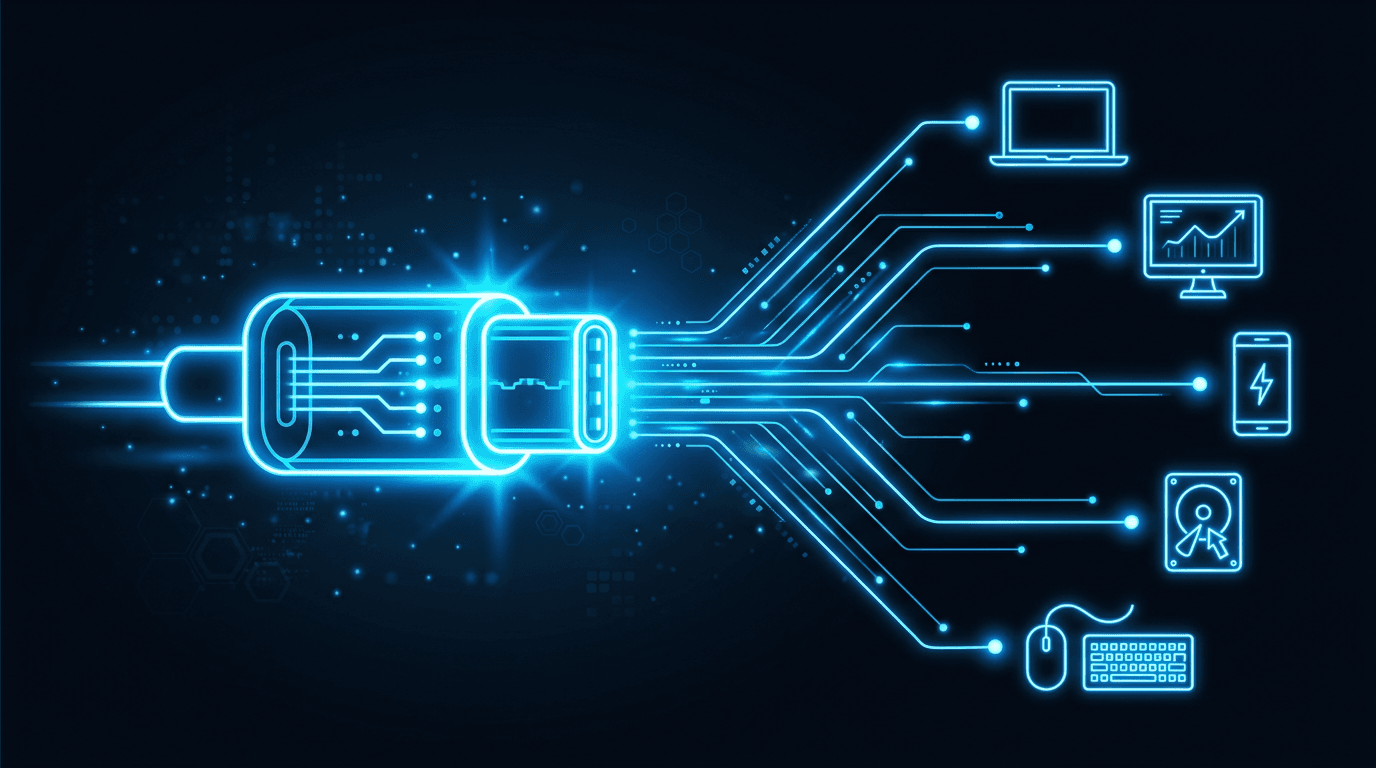
MCP Is the USB Port for AI Agents
The Model Context Protocol solves the same N x M integration problem that USB solved for hardware. One standard connector, any AI client, any tool. Here is why MCP won, what it does not do, and what your team should build now.
Everyone over the age of 30 has a drawer somewhere full of proprietary cables. A Nokia charger that fits exactly one phone. A Sony memory stick that works in exactly one camera. A printer cable with a connector shape that some engineer in 1998 thought was a good idea.
That drawer is a monument to a specific engineering failure: the N x M integration problem. When every device manufacturer invents their own connector, connecting N devices to M peripherals requires up to N x M custom cables. Ten computers and ten printers meant up to one hundred different cables.
If you have built AI integrations in the last three years, you know this problem intimately. Connecting 20 AI models to 20 enterprise systems - Slack, GitHub, Salesforce, your database, your internal tools - requires up to 400 custom integration adapters. Every model provider has its own function calling format. Every tool has its own API shape. Every connector is bespoke.
The Model Context Protocol (MCP) is the USB port for this problem. And like USB, it is winning not because it is the most technically sophisticated option - but because it is universal.
What USB Did
Intel released the USB 1.0 specification in January 1996. The data transfer rate was 12 megabits per second. Apple's FireWire (IEEE 1394), released the same year, ran at 400 megabits per second - over 30 times faster.
FireWire was objectively better on the technical merits. Faster transfer speeds, peer-to-peer architecture, lower CPU overhead. Professional audio and video editors loved it. Apple charged a licensing fee per port.
USB won anyway. Not because of speed. Because of universality.
Why USB Beat FireWire
Any manufacturer could implement USB without licensing fees. FireWire charged $0.25 per port. At scale, free beats better.
Intel, Microsoft, Compaq, DEC, IBM, NEC, and Nortel backed USB from the start. One company (Apple) backed FireWire. Broad coalitions beat single-vendor standards.
The peripheral did not care who made the computer. The computer did not care who made the peripheral. This decoupling is what made the ecosystem possible.
The Pattern
MCP by the Numbers
Anthropic released MCP in November 2024. Sixteen months later, the adoption numbers tell a clear story.
97 million
Monthly SDK downloads by March 2026. For context, React had roughly 90 million monthly npm downloads at a similar point in its adoption curve.
1,800+ active servers
Public MCP servers registered and maintained. Every one of these is a tool that any MCP-compatible AI client can use without custom integration work.
28% of Fortune 500
Have deployed MCP in production. Not piloting. Not evaluating. Deployed.
Universal adoption
OpenAI, Google, Microsoft, and Anthropic all support MCP. When every major AI provider adopts the same protocol, that is not a trend - that is infrastructure.
In December 2025, Anthropic donated MCP to the Linux Foundation's Agentic AI Foundation (AAIF). This mirrors USB's path - Intel created it, then handed governance to the USB Implementers Forum so no single company controlled the standard. Neutral governance is what turns a corporate project into industry infrastructure.
Organizations deploying MCP report a 70% reduction in AI operational costs and 50-75% savings in development time for tool integrations. Those numbers make sense when you understand the problem MCP solves.
Before MCP vs. After MCP
The difference is easiest to see with a concrete example. Say you want your AI agents to interact with Slack - reading channels, posting messages, searching history.
Before MCP
- Write a custom Slack adapter for Claude
- Write a different adapter for GPT-4
- Write another for Gemini
- Maintain three separate authentication flows
- Handle three different function calling formats
- Debug each one independently when Slack changes their API
Estimated: 120+ engineering hours per AI provider.
After MCP
- Build one MCP server for Slack
- Claude connects to it
- GPT-4 connects to it
- Gemini connects to it
- Any future MCP-compatible model connects to it
- One update when Slack changes their API
Estimated: 40 engineering hours, once.
The same keyboard that works with every computer via USB is now the same Slack server that works with every AI model via MCP. The peripheral does not care who made the computer. The MCP server does not care which model is calling it.
The N x M Problem, Solved
The math is straightforward. Without a standard protocol, connecting N AI models to M enterprise systems requires up to N x M custom connectors. Twenty models times twenty systems equals four hundred adapters to build and maintain.
MCP reduces this to N + M. Build one MCP server per system (twenty servers), and every MCP-compatible client can access all of them. Twenty plus twenty equals forty. That is a 10x reduction in integration work - and the ratio improves as the ecosystem grows.
The Math
20 models x 20 systems = 400 adapters. Each one has its own authentication, error handling, data format translation, and maintenance burden.
20 MCP servers + 20 MCP clients = 40 integrations. Each server is built once and serves every client. Each client connects to every server with the same protocol.
This is the same insight that made USB successful. Before USB, a printer manufacturer had to build a different interface for every computer maker. After USB, they built one interface and it worked everywhere. The value of the standard grows with every new participant on either side - a classic network effect.
What MCP Does Not Do
MCP is a tool protocol. It connects an agent to tools, databases, APIs, and services. The agent acts; the tool responds. This is USB - a connector between a computer and a peripheral.
What MCP does not do is connect agents to each other. It does not handle agent-to-agent discovery, negotiation, collaboration, or payment. It is USB, not Wi-Fi. For agent-to-agent communication, you need agent protocols - and that is a different (complementary) problem.
USB vs. Wi-Fi
MCP is also still maturing. Honest assessment of the current limitations:
Transport is evolving
The original stdio transport works for local servers. The Server-Sent Events (SSE) transport has limitations for bidirectional communication at scale. The newer Streamable HTTP transport addresses many of these issues, but migration is ongoing.
Authentication and authorization are early
The OAuth 2.1 integration for remote MCP servers is recent. Fine-grained permission models - which tools an agent can call, with what data, under what conditions - are still being defined. Enterprise deployment requires careful attention to what your MCP servers expose.
Security surface area is real
An MCP server that exposes database access to AI agents is a powerful capability and a meaningful security surface. Prompt injection attacks that trick an agent into misusing a tool are a known risk. Treat MCP servers with the same security discipline you apply to any API endpoint.
None of these are reasons to avoid MCP. They are reasons to adopt it with clear eyes. USB 1.0 had real limitations too - 12 Mbps was painfully slow for large file transfers. The ecosystem grew anyway because the abstraction was right, and the implementation improved over time. MCP's abstraction is right. The implementation is improving rapidly.
The USB-C Lesson
USB-C is the most instructive chapter in this analogy. When USB-C launched, it unified three things that had been separate: data transfer, power delivery, and display output. One port replaced USB-A, micro-USB, Lightning, HDMI, and dedicated power connectors.
MCP is heading in a similar direction. The protocol defines three core capabilities through one connection:
Tools
Functions that the AI can call - executing code, sending messages, querying databases. This is the equivalent of USB data transfer.
Resources
Structured data the AI can read - files, database records, API responses. This is the equivalent of USB storage access.
Prompts
Reusable prompt templates that the server provides to the AI. Context and instructions through the same connection.
But USB-C also taught us that convergence takes time and involves friction. It took years for manufacturers to adopt USB-C fully. Early USB-C cables had wildly inconsistent quality. The European Union had to mandate USB-C as the standard charging port. Apple held onto Lightning until 2023.
MCP's path will not be smooth either. Different AI providers will implement the spec with varying levels of completeness. Server quality will vary. Some organizations will build proprietary alternatives because they think their use case is special (it usually is not). The trajectory is clear, but the transition has bumps.
The Lesson
What This Means for Your Team
Three concrete actions. No hand-waving.
If you expose an API, build an MCP server
Your REST API serves human-built applications. An MCP server serves AI agents. These are different clients with different needs - agents benefit from structured tool definitions, resource descriptions, and context that a raw API endpoint does not provide. If you want AI agents to use your product, give them the connector they speak.
If your agents use tools, connect via MCP
Stop writing custom adapters for each tool. If an MCP server exists for the service you need, use it. If it does not exist, build one - and contribute it to the ecosystem. The next team that needs the same integration saves the same 120 engineering hours you would have spent.
Separate tool integration from business logic
The protocol will evolve. Transports will change. Authentication models will mature. If your business logic is tangled with your MCP implementation, every protocol update becomes a refactor. If your tool integration is a clean boundary - a layer your business logic talks to without knowing the protocol details - updates are contained. This is not MCP-specific advice. It is architecture advice that MCP makes urgent.
How We Use MCP at Fetch.ai
At Fetch.ai, MCP is the tool integration layer across our product ecosystem. The agent protocols - Chat Protocol, Payment Protocol - handle agent-to-agent coordination. MCP handles agent-to-tool connectivity. Both layers work together, but neither depends on the other.
Flockx
The "Connect Any Tool with MCP" feature lets creators plug their AI team into external services - design tools, analytics platforms, publishing systems - through MCP servers. One connection per tool, available to every agent on the team. No custom adapters per agent.
ASI:One
Personal AI agents use MCP to access tools on behalf of users - calendars, email, documents, project management systems. The user connects the MCP server once. The AI handles the rest. As we wrote in Hire the Robots, the goal is AI that handles the work humans should not have to do.
The separation between tool protocols and agent protocols is not theoretical for us - it is how the architecture works in production. MCP gives individual agents hands. The Chat Protocol and Payment Protocol give them voices and wallets. Together they create agents that can both use tools independently and coordinate with each other.
In 1998, you could have built a better proprietary connector than USB. Faster, more elegant, technically superior. And you would have lost - because the market converged on the universal standard, not the best one. Today you could build a better proprietary tool integration protocol than MCP. And you would lose for the same reason.
MCP is the USB port for AI agents. The connector is standard. The ecosystem is building. Your choice is whether to plug in now or build another proprietary cable for the drawer.
Build tool integrations that scale
Our team builds multi-agent systems with MCP and agent protocols at Fetch.ai, ASI:One, and Flockx. If you are architecting AI tool integrations and want to discuss MCP strategy, I am happy to share what we have learned.