Hiring for the Multiplier
Most hiring loops produce a thumbs-up or thumbs-down. A multiplier loop produces evidence. Three question archetypes, a written-first debrief, a reference check that surfaces peer-effect behavior, and a no rule that holds the floor. The operational practice behind the multiplier math.
Most teams hire when their loop fails to surface a clear no, not when it produces a clear yes. That is how the floor slides. It is also why a leader who audits a year of hiring decisions in good faith will often find that the worst hires on the team each had at least one interviewer who was unenthusiastic, couldn't quite articulate why, and got talked into a yes by the energy of the room.
We wrote the math behind this in The Multiplier Math: a bad hire drags the floor 30 to 40 percent across everyone they touch, a great hire lifts the ceiling 5 to 15 percent, and the asymmetry compounds quarter over quarter. If composition is rank-1 leverage, the hiring loop is the highest-leverage process a leader owns. The loop that respects the math is structured, evidence-led, and biased toward the no.
What this post delivers
This is an operational post. Every section should produce an artifact you can add to the loop before the next candidate is scheduled.
What candidates cannot hide
The premise under the multiplier interview is simple. Candidates can rehearse their technical answers, their behavioral stories, and their resume narrative. The three things they cannot rehearse, because the rehearsal itself reveals the pattern, are how they talk about other people's contributions, how they describe feedback that landed hard, and how they describe a disagreement where they did not get their way. Those three signals are where multiplier behavior leaks through the performance.
Positive multipliers
Credit teammates by name. Describe wins as collective and know the specific contribution of specific people. Describe hard feedback as information, often with gratitude toward the person who gave it. Reconstruct the other side's argument accurately when describing a disagreement they lost.
Negative multipliers
Use "I" disproportionately. Credit abstract "the team" when pressed on who did what. Describe hard feedback as unfair, poorly delivered, or cannot recall any. Describe disagreements they lost as instances where the organization made the wrong call.
Laszlo Bock's Work Rules! (2015) is the operational reference for structured behavioral interviewing at scale. Colin Bryar and Bill Carr's Working Backwards (2021) documents Amazon's Bar Raiser practice as the structural embodiment of the same instinct: a designated interviewer whose job is to hold the floor rather than close the hire. The archetypes that follow are how we operationalize the same research inside our loops.
Structured interviews and work samples outperform everything
We made the case briefly in The Multiplier Math. Schmidt and Hunter's 1998 meta-analysis in Psychological Bulletin is still the best available evidence that structured interviews and work-sample tests are the two highest-validity hiring signals available to a team. Unstructured conversation is worse than most people believe, including most people who run hiring loops.
What "structured" means in practice is the same questions in the same order scored against the same rubric. What "work sample" means in practice is a task close to the work the candidate would do on day ninety, not a puzzle designed to show off the interviewer's cleverness. Most teams run unstructured loops because it feels more human, and the loop's customers - the interviewers - like it more than its consumers - the candidates and the team downstream of the hire. Unstructured loops optimize for the interviewer's experience. Structured loops optimize for the signal quality. The math from the previous post tells us which trade to make.
Three multiplier question archetypes
The archetypes below are the core operational contribution of this post. Each synthesizes established research with our own learning. Use them in every loop, ask them in roughly the same wording every time, and score the answers against the same rubric.
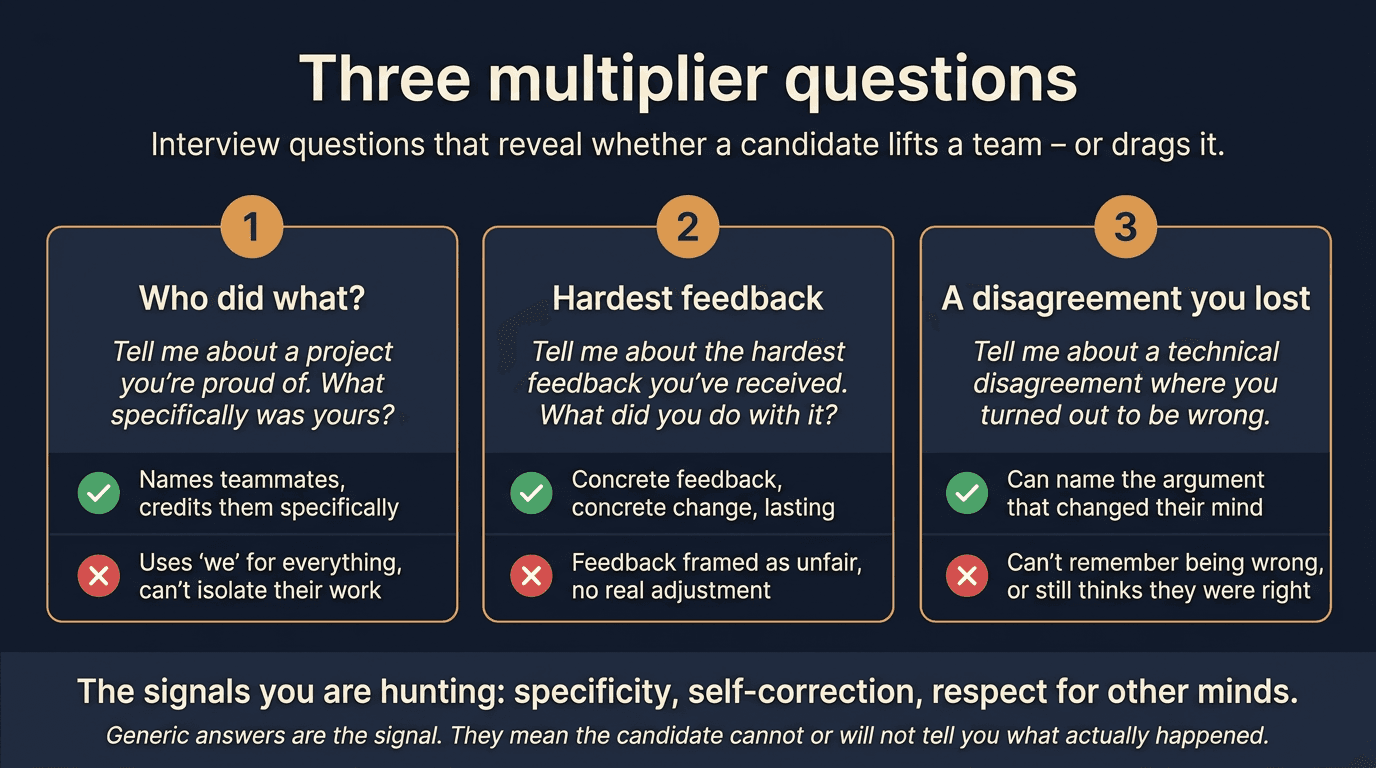
Archetype 1: The "who did what" question
Ask: "Walk me through the last project you shipped. For each major piece, tell me who did it, what they did, and what I would hear if I called them."
Positive signal: the candidate credits peers by name, knows what those peers actually did, and is visibly proud of their peers' work. They can describe a specific decision a teammate made that improved the shape of the project.
Negative signal: the candidate speaks in "I" for work that almost certainly was not theirs alone, describes their team as "they" rather than "we," or gets vague when asked to attribute a specific contribution to a specific person.
Archetype 2: The "hard feedback" question
Ask: "Tell me about the hardest piece of feedback you have ever received. Who gave it, what did they say, what did you do with it, and would they say today that you acted on it?"
Positive signal: the candidate treats feedback as information, describes a specific behavioral change that followed, and names the person who gave it with respect. Amy Edmondson's The Fearless Organization (2018) is the research spine - teams in which feedback flows safely outperform teams in which it is politicized, and the candidate's answer is a proxy for which direction they push the culture around them.
Negative signal: the candidate describes feedback as wrong, unfair, or poorly delivered. They cannot recall any hard feedback. They describe the person who gave it in neutral or negative terms. They describe the "lesson" as a generic platitude ("be more confident") rather than a specific change.
Archetype 3: The "disagreement you lost" question
Ask: "Tell me about a decision where you pushed hard for one path and the team chose another. Walk me through the other side's argument as they would have made it, and tell me what you did after the decision."
Positive signal: the candidate can reconstruct the opposing argument charitably, acknowledges merits of the decision that was made, and describes a specific disagree-and-commit behavior - they continued to execute well after the decision went against them.
Negative signal: the candidate describes the lost disagreement as evidence that the organization was broken. They cannot steelman the other position. They describe continuing to push privately, re-litigating the decision, or routing around it. That is the shape of the affective-negative pattern Felps, Mitchell, and Byington (2006) documented in the bad-apple research we cited in the previous post - the pattern most likely to drag the team down around them.
These archetypes synthesize Bock's structured-interview discipline from Work Rules! (2015), Edmondson's feedback-culture research from The Fearless Organization (2018), and our own operational learning from running loops that tried to surface multiplier behavior directly rather than hoping for it to show up accidentally. The integrated question set and scoring rubric are ours.
The debrief that raises the bar
Most debriefs converge on a group feel. The multiplier debrief runs on evidence. Three structural rules, each designed to protect the floor against the pressure of the room.
Rule 1: Written-first
Every interviewer writes their recommendation and the specific evidence behind it before the debrief meeting. Nobody sees anyone else's notes until their own is submitted. This preempts the halo effect Kahneman describes in Thinking, Fast and Slow (2011), where strong early opinions anchor subsequent evaluators and the debrief becomes a re-derivation of the first speaker's conclusion. If the debrief produces a divergent set of written recommendations, that divergence is itself information worth working through.
Rule 2: The two multiplier questions are always in the template
Every debrief form asks the same two questions before it asks anything else. Would this person raise the team's average? Would their presence raise the bar for the next hire we make? Two yeses is a hire. Anything else is a pass. The rest of the form is evidence and concern, not vote-counting.
The hiring manager adds one more question for themselves: would I follow this person into a hard problem I did not know the answer to? It is not a veto by itself, but a no here is a red flag that should not be rationalized away.
Rule 3: The no rule
Any single interviewer on the panel can veto a hire. A veto stands unless every other interviewer agrees to revisit it and a specific concern is resolved. This is the opposite of the default yes rule where consensus-to-hire is the bar and a single skeptic gets rolled. The no rule holds the floor at the cost of throughput. Given the asymmetric math from the previous post, we would rather miss a candidate than admit one the panel was not certain about.
Amazon's Bar Raiser practice, as described in Bryar and Carr's Working Backwards (2021), is the structural embodiment of the no rule: a designated interviewer on every loop whose only job is to hold the floor, who has no incentive to close this specific hire, and who is unrelated to the hiring team. We do not require a formal Bar Raiser program to run a no rule, but naming a single person on every loop whose explicit charter is to protect the bar tends to produce the same outcome. Reed Hastings and Erin Meyer's No Rules Rules (2020) is the talent-density case for why the trade between throughput and floor is the correct one to make.
Operational note on the no rule
The reference check that surfaces multiplier behavior
Reference checks are the most under-invested step in most hiring loops and often the step where multiplier signal is clearest, because the candidate is not in the room and the reference is not trying to land the offer. Claire Hughes Johnson's Scaling People (2023) is explicit that references should be checked by the hiring manager personally, not delegated to a recruiter, and we hold the same discipline.
The question library we use:
- Who are the three people they worked most closely with, and how would those people describe working with them?
- If they had to replace themselves on your team, who would they have recommended, and why?
- Walk me through the hardest conversation you had with them. What was it about, and how did they handle it?
- How would you describe them to someone thinking of hiring them for a similar role? Now how would you describe them to someone thinking of promoting them into a role two levels up? The gap between those two answers is the signal.
- If you were starting a new team tomorrow, would you hire them again? What role, and why that role?
The last question is the rehire test from Andy Grove's High Output Management (1983) applied backward to references. A hesitation on the rehire answer is the single most predictive negative signal we have found in reference conversations. A confident yes with a specific role and a specific reason is the inverse.
When you hire strong skill with multiplier risk anyway
The hard case is the candidate with exceptional skill and ambiguous multiplier signals. The research on this pattern is not ambiguous - high-skill, low-multiplier individuals deliver their own output and suppress five to ten others', and the compounding math from the previous post says the net is negative on almost every reasonable assumption. But operationally, the alternatives sometimes look worse in the moment: a critical gap, a shipping deadline, a role that nobody else has applied for. The math still says pass. The operational reality is that teams do it anyway sometimes. If you are going to, do it with guardrails.
Name the concern in writing
Pair them with a strong-multiplier peer
Define the exit threshold in the offer-internal debrief
Revisit the offer at thirty, sixty, and ninety days
How to start tomorrow
The loop is too big to "adopt." It is small enough to start practicing before the next candidate is scheduled. Pick one of the four moves and make it this week. The others will follow naturally once the first one is a habit.
Add the three question archetypes to the next loop
Add the two multiplier questions to the debrief
Name a bar raiser and give them the no rule
Replace the default reference-check script
The loop is how the math becomes a practice
The math in The Multiplier Math says hiring is where the multiplier is born. The loop in this post is how the math becomes a practice. Structured questions, a written-first debrief, a no rule that is emotionally safe to cast, and a reference check that surfaces how a candidate behaves in the room they are not currently in. Each component is a small discipline. Together they raise the floor the team has to stand on.
Once someone is on the team, a different doctrine takes over. The next post in this series is lead, coach, or manage out - how to decide which of the three moves a struggling team member's situation actually calls for, how to tell coaching apart from micromanaging, and what measures of success belong in a decision that serious. After that: coaching across functions, the development engine of objectives and peer review and structured feedback, and the hard half of building a team - the exit conversation run with respect. Each one is downstream of the loop in this post and the math in the last.
Upgrade your next loop
If you are building a team where hiring loops are treated as the highest-leverage process a leader owns, where the multiplier questions are written into the debrief, and where the no rule is emotionally safe to cast, we should talk.